
Skim Coating In Western MA
25 Years of Experience Skim coating walls and ceilings smooth. We stand behind our work with a 3 year warranty
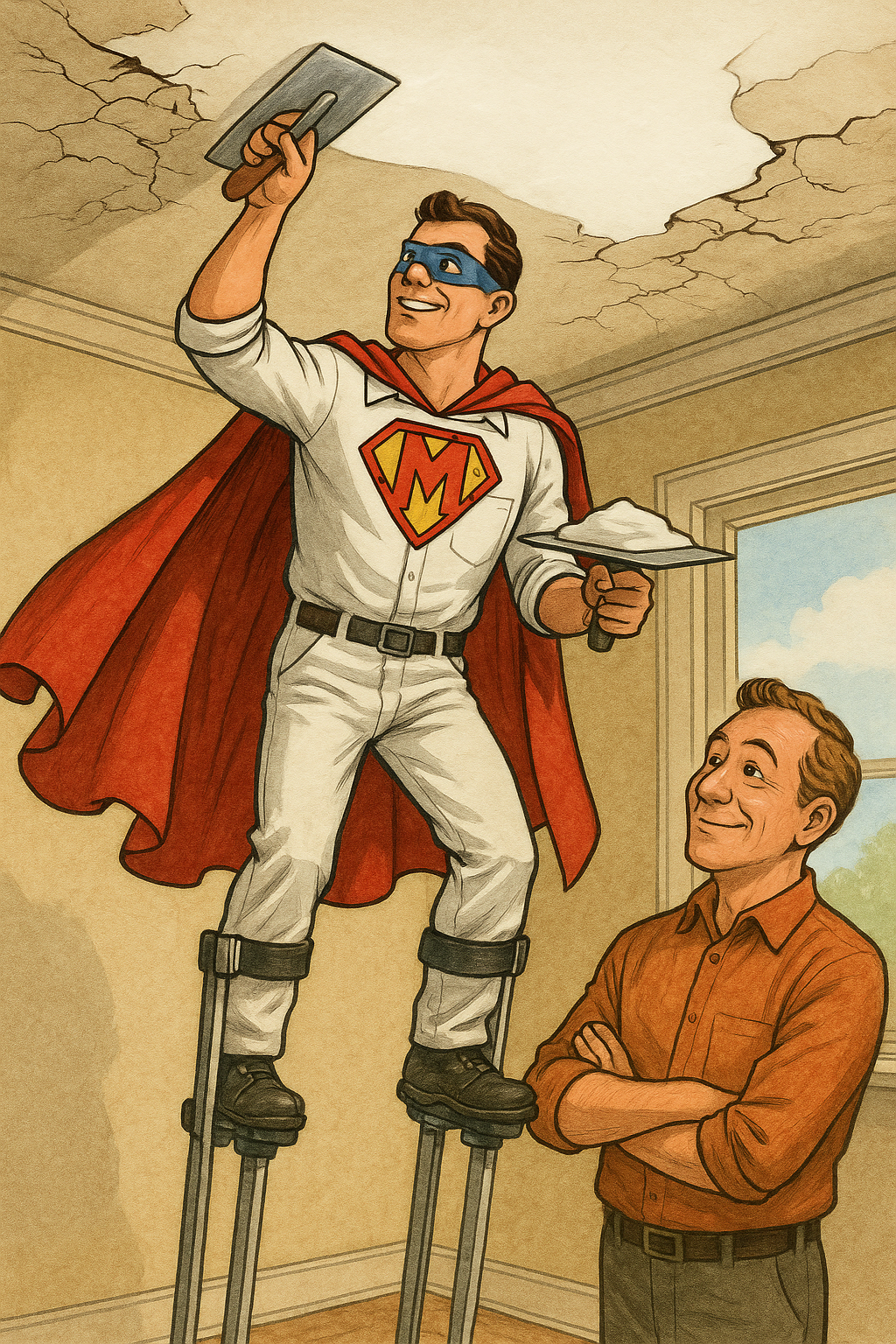
MrWalls Drywall & Painting — Western Massachusetts
Skim Coat Walls in and ceilings smooth throughout the Pioneer Valley
Skim coating is the finishing trade that separates average walls from exceptional ones. MrWalls applies smooth, trowel-finished skim coats across walls and ceilings throughout the Pioneer Valley, transforming rough, uneven, or damaged surfaces into something worth painting.
·Springfield · Chicopee · Holyoke · Northampton & Beyond
A skim coat is the difference between a wall that looks finished and a wall that looks truly done. Whether you are covering old wallpaper damage, refreshing tired plaster, or bringing a renovated room to a glass-smooth Level 5 standard, MrWalls delivers skim coat work that holds up under every sheen and every light angle in Western Massachusetts homes.
Skim coating is one of the most misunderstood services in the drywall trade. Many homeowners have heard the term but are not quite sure what it involves or when they need it. Others know they have walls that do not look right and do not know what to call the problem. The answer, in many of those cases, is a skim coat.
A skim coat is a thin layer of joint compound or finish plaster applied across an entire wall or ceiling surface and troweled smooth. It covers texture inconsistencies, fills surface porosity differences, conceals old wallpaper damage, refreshes deteriorated plaster, and brings any surface to the flat, uniform plane that high-quality paint demands. It is the finishing craft that turns adequate walls into exceptional ones, and MrWalls Drywall and Painting performs it across homes and commercial spaces throughout Western Massachusetts.
What Is a Skim Coat and When Do You Need One
A skim coat is applied in one or two very thin passes across the entire surface of a wall or ceiling, not just over seams or repairs. The goal is a uniform layer that bridges all variations in the substrate beneath, producing a surface that is flat, smooth, and consistent from edge to edge. Once sanded and primed, a properly skim-coated surface accepts paint beautifully and reveals no underlying imperfections regardless of sheen level or lighting angle.
The need for a skim coat is most often revealed by light. When a raking light source, such as afternoon sun through a window or a work light held close to the wall, travels across a surface and shows ridges, trowel marks, suction spots, old seams, or texture inconsistency, that surface is telling you it needs a skim coat before it is ready for quality paint. MrWalls reads walls the same way and gives you an honest assessment of what they actually need.
When Skim Coating Is the Right Solution
Skim coating is not always the answer, but there is a wide range of situations where it is clearly the correct one. Here are the most common scenarios MrWalls addresses with skim coat work across Western Massachusetts.
Most Requested
Wallpaper Removal Damage
Removing wallpaper almost always damages the drywall face paper beneath it, leaving torn fibers, adhesive residue, and uneven porosity. A skim coat is the only reliable way to restore a wall to a paint-ready surface after wallpaper removal.
Very Common
Level 5 Finish
New drywall brought to a premium smooth finish for satin, semi-gloss, or any high-sheen paint application. Required wherever gloss paint will reveal the porosity difference between compound and face paper.
Very Common
Plaster Wall Refinishing
Older plaster walls in Pioneer Valley homes that have become rough, cratered, or inconsistent over decades. A skim coat brings them back to a smooth, uniform surface without full demolition and replacement.
Common
Texture Removal and Smoothing
Walls or ceilings that had orange peel, knockdown, or other applied texture that the homeowner wants to smooth out. The existing texture is skim coated over to produce a flat, modern surface.
Common
Renovation Surface Restoration
Walls in renovated rooms that have accumulated years of patch repairs, multiple paint layers, and surface inconsistencies. A skim coat unifies the surface and gives the renovation a finished quality that patching alone cannot achieve.
Common
Pre-Sale Home Preparation
Walls in homes being prepared for the Western MA real estate market. Fresh skim coat followed by new paint is one of the highest-return investments a seller can make before listing.
The Wallpaper Removal Problem in Western Massachusetts Homes
Wallpaper removal is one of the most common reasons Western Massachusetts homeowners call MrWalls for skim coat work. Older homes throughout Springfield, Northampton, Holyoke, and Chicopee have layers of wallpaper applied over decades, and removing it almost always damages the surface below. The damage is not always visible until the wall is painted, at which point torn face paper, adhesive staining, and porosity variations show through as blotchy, rough, and uneven sections that no amount of additional paint coats will resolve.
Painting directly over a wall from which wallpaper has been removed, without a skim coat, is one of the most reliable ways to produce a paint result you will be unhappy with. The torn face paper fibers raise when wet paint is applied, the adhesive residue bleeds through standard latex paint, and the porosity variations cause paint to absorb unevenly and appear blotchy once dry. MrWalls skim coats wallpaper-removed walls before any paint goes on. There is no shortcut to a good result on these surfaces.
What About Skim Coating Over Existing Wallpaper
In some situations, particularly where wallpaper is very old, multiple layers deep, and removal would be highly destructive to the plaster beneath, skim coating over the existing wallpaper is a legitimate option. The seams must be reinforced, the surface must be primed with an oil-based primer to prevent the skim compound from activating the wallpaper adhesive beneath, and the skim coat must be applied in thin passes to avoid excess moisture that could cause bubbling. MrWalls assesses each situation individually and recommends the approach that produces the best lasting result for the specific surface and home.
Skim Coating Plaster Walls in Older Pioneer Valley Homes
Western Massachusetts has one of the most significant concentrations of pre-1940 housing in New England. Homes throughout Springfield, Northampton, Holyoke, Westfield, and the surrounding communities were built with plaster walls that have lasted generations. Over time, those plaster surfaces develop a character all their own: small craters from nail holes and screws, surface roughness from years of repainting, hairline networks of age cracks, and areas where finish plaster has abraded or worn thin.
A skim coat applied over sound plaster brings it back to life. Rather than replacing plaster systems that are structurally intact and part of the historic character of the home, a thin finish skim coat fills the surface irregularities, restores the flat plane, and provides a fresh substrate that accepts modern paint beautifully. The result is a wall that feels as solid and substantial as the original plaster, because the original plaster is still there beneath the finished surface.
MrWalls tip for owners of pre-1940 homes in the Pioneer Valley: skim coating over sound plaster is almost always preferable to replacing it with drywall. Plaster walls are denser, more fire-resistant, and better at blocking sound than standard drywall. They also contribute to the thermal mass and acoustic character of older homes in ways that drywall does not replicate. If the plaster is structurally sound, preserving it and refreshing the surface with a skim coat is both the more economical and the more historically appropriate choice.
Skim Coat Walls vs. Level 5 Finish on New Drywall
On new drywall, the term skim coat is often used interchangeably with Level 5 finish. The two are related but not identical. A Level 5 finish is the industry standard designation for a skim coat applied over fully taped and finished drywall to eliminate the porosity difference between the joint compound and the face paper. Without that skim coat, high-sheen paint absorbs differently into compound areas versus face paper areas and produces a phenomenon called photographing, where every seam and fastener location becomes visible through the paint under certain lighting conditions.
If you are planning satin, semi-gloss, or gloss paint anywhere in your Western Massachusetts home, specify Level 5 finish on those walls. The cost difference between Level 4 and Level 5 is modest. The visual difference once the paint is on and the light hits at an angle is not modest. MrWalls will always advise on the correct finish level for the paint system you are planning before any work begins.
Our Skim Coat Services
MrWalls handles the full range of skim coat and wall refinishing work for residential and commercial clients across Western Massachusetts.
🖼️
Wallpaper Removal and Skim Coat
Complete wallpaper removal followed by full skim coat restoration of the underlying surface. One project, one contractor, wall to paint-ready finish.
✨
Level 5 Finish on New Drywall
Full surface skim coat over finished drywall for premium paint applications. Required for gloss, semi-gloss, or any high-end interior finish.
🏛️
Skim coat over sound existing plaster to restore a flat, smooth surface in older Pioneer Valley homes without full wall replacement.
🔲
Texture Smoothing
Skim coating over existing wall or ceiling texture to produce a smooth, flat surface for homeowners moving away from orange peel or knockdown finishes.
🔧
Renovation Surface Unification
Full room skim coat bringing together surfaces that have been patched, repaired, and repainted multiple times into a single consistent plane.
🎨
Skim coated walls primed and painted to finish. MrWalls completes the full sequence from raw surface to painted room in one engagement.
The MrWalls Skim Coat Process
A professional skim coat is not simply spreading compound on a wall and sanding it smooth. It is a layered process that requires proper substrate preparation, correct product selection, trowel technique built over years of practice, and a final inspection standard that uses light rather than just touch to verify quality. Here is exactly how MrWalls approaches every skim coat project.
-
Surface assessment. Before any compound is mixed, we assess the condition of the wall. We check for loose material, active moisture, wallpaper adhesive residue, glossy paint layers, oil-based paint, and any structural issues that would compromise a skim coat applied over them. Every condition found at this stage determines the preparation steps that follow.
-
Substrate preparation. Loose plaster is re-secured or removed. Wallpaper adhesive residue is cleaned from the surface. Damaged face paper on drywall is stabilized. Large voids or deep craters are pre-filled so the skim coat can be applied at a consistent thin thickness rather than thick in some areas and thin in others.
-
Primer selection and application. The correct primer is applied before any skim compound touches the wall. Bare drywall and torn face paper require PVA drywall primer. Walls with wallpaper adhesive require an oil-based primer to seal residue and prevent bleed-through. Plaster walls with heavy porosity require a penetrating sealer. Skipping or substituting the primer coat is the most common cause of skim coat failure, and MrWalls does not skip it.
-
First skim coat application. A thin layer of finishing compound is troweled across the entire primed surface. The goal of the first coat is adhesion and coverage, filling the primary surface irregularities while establishing a consistent base for the second coat. Trowel technique at this stage sets the flatness of everything that follows.
-
Drying and light inspection of first coat. The first coat is allowed to dry fully. Before the second coat is applied, we inspect the dried surface under raking light to identify high spots, voids, and any areas where the first coat pulled away or was applied too thick. These are addressed before the second coat is applied over them.
-
Second skim coat application. The second coat is applied thinner than the first, focused on leveling the surface plane and eliminating the trowel marks and texture variations left by the first coat. This is the coat that produces the final surface quality, and it requires the most refined technique of the process.
-
Sanding. Fully cured skim coats are sanded with fine-grit paper on a pole sander for large flat areas and by hand in corners and detail areas. Sanding is done dry and under controlled conditions. Wet sanding introduces too much moisture into a thin skim coat and can re-soften areas that have not fully cured.
-
Raking light final inspection. Before any primer or paint is applied, the finished surface is inspected under a raking work light held low and parallel to the wall. This is the standard that reveals any remaining trowel marks, ridges, or low spots that normal overhead lighting would hide. If the surface does not pass this inspection, additional sanding or spot touch-up is completed before moving forward.
-
Final prime coat. The finished, sanded skim coat is primed with a quality sealer before paint. New skim compound is highly porous and will absorb paint unevenly if applied without primer, resulting in a blotchy finish regardless of how many paint coats are applied. The primer coat seals the surface uniformly and is the final step before paint.
Why Skim Coating Is a Skilled Trade
Skim coating looks simple when it is done well. That is precisely the point: a perfectly skim-coated wall reveals nothing of the technique required to produce it. In practice, troweling compound to a truly flat and uniform surface across the full plane of a wall, in multiple passes, without leaving trowel lines, holidays, or high edges at the perimeter, is a skill that takes years to develop. The tools are simple. The technique is not.
The most common failure modes in amateur skim coating are trowel marks that show through paint under raking light, ridges at overlap lines where compound was recoated before the underlying area was fully cured, edges that build up at the perimeter of rooms because the trowel angle was too steep at the margins, and over-sanding that cuts through the skim coat back to the substrate in thin areas. MrWalls finishers are trained specifically in flat trowel work and bring that training to every skim coat project across the Pioneer Valley.
Why MrWalls for Skim Coat Walls in Western Massachusetts
MrWalls Drywall and Painting is a locally owned Western Massachusetts contractor with extensive experience in skim coat work across every type of substrate found in Pioneer Valley homes. We have skim coated plaster walls in nineteenth-century Northampton colonials, restored drywall surfaces after wallpaper removal in mid-century Springfield ranches, and brought new construction to Level 5 standard for high-end finishes in Westfield and Longmeadow. The surface conditions here are as varied as the housing stock, and MrWalls knows how to read and address each one.
-
Correct primer specified for every substrate, PVA for bare drywall, oil-based for wallpaper adhesive, penetrating sealer for porous plaster.
-
Raking light inspection standard applied before any primer or paint is allowed on the finished surface.
-
Full plaster and drywall capability, skim coat work on any substrate found in Pioneer Valley homes of any era.
-
Wallpaper removal and skim coat in one project, no separate contractors and no coordination gaps between trades.
-
Full drywall and painting services available, one contractor takes a wall from raw substrate through finished painted surface in a single engagement.
-
Licensed, insured, and locally owned, a Pioneer Valley contractor whose work is visible every day in homes and businesses across Western Massachusetts.
Frequently Asked Questions
-
How long does a skim coat take to dry before painting?
Each skim coat application needs to be fully dry before the next is applied, which typically means twenty-four hours in normal conditions. After the final coat is sanded and primed, most surfaces are ready for paint within another twenty-four hours. Temperature and humidity affect drying time considerably in Western Massachusetts, particularly in winter when interior heating creates dry conditions that accelerate curing and in summer when high humidity can slow it significantly. MrWalls monitors conditions throughout the project and adjusts scheduling accordingly.
-
Can I skim coat over existing paint?
Yes, with proper preparation. The existing painted surface must be clean, stable, and not actively peeling or flaking. Glossy surfaces require sanding or a bonding primer before skim compound will adhere reliably. Surfaces painted with oil-based products require an oil-based bonding primer. MrWalls assesses painted surfaces during the pre-project walkthrough and specifies the correct primer system for the substrate before any skim compound is applied.
-
Is skim coating the same as plastering?
They are closely related but use different materials in most modern applications. Traditional plastering uses lime-based or gypsum-based plaster applied in multiple coats over lath, achieving significant wall thickness and structural mass. Skim coating typically uses joint compound or finishing compound applied in very thin passes over an existing substrate to improve the surface quality of that substrate. In some applications, particularly in older plaster restoration, finish plaster is used for skim coat work. MrWalls uses the appropriate material for the specific application and substrate.
-
Do I need to skim coat the whole room or just the damaged areas?
It depends on the condition of the undamaged areas and the paint sheen you are planning. For flat or matte paint in a room with walls that are generally in acceptable condition, targeted repairs may be sufficient. For satin or semi-gloss paint, or in rooms where the existing walls show significant variation across the surface, a full room skim coat produces a dramatically more consistent result than patching alone. MrWalls will assess your specific walls and give you an honest recommendation based on what the paint system will reveal, not on which scope is larger.
-
Can MrWalls paint the walls after skim coating?
Yes. MrWalls Drywall and Painting handles the complete sequence from skim coat through final painted finish. We prime the skim coated surface with the appropriate sealer, apply two full coats of your chosen paint product, and leave the room completely finished. Completing both the skim coat and the painting in one engagement eliminates the gap between trades and ensures the primer and paint system is appropriate for the specific substrate we produced.
Serving Western Massachusetts Communities
MrWalls provides skim coat services throughout Western Massachusetts, including Springfield, Chicopee, Holyoke, Westfield, Northampton, Easthampton, Agawam, Ludlow, Wilbraham, East Longmeadow, Longmeadow, South Hadley, Amherst, Belchertown, Palmer, Ware, and surrounding communities across Hampden and Hampshire Counties. Whether you have one room with wallpaper damage or a whole house of plaster walls ready for refinishing, MrWalls brings the same standard of trowel work and surface quality to every project.
Contact MrWalls Drywall & Painting
Walls That Deserve Better?
MrWalls delivers professional skim coat work across Western Massachusetts, from wallpaper damage restoration to Level 5 premium finish on new construction.
Call or email us today: (413) 302-0640 · Service@MrWalls.Net
Request a Free Estimate ↗
”Very Dependable and fair.”
– Mary from Holyoke MA


”Reasonable price, Excellent experience! I was in a bind and was on a time constraint, and Jason was extremely accommodating and sensitive to my dilemma! The job turned out great! Thank you, Jason!”
– Dianna from Agawam MA
”Great Job, reliable and trustworthy. He comes when he says he will”
– Maureen from Springfield MA
”Jason was friendly and on time. He did a nice job. He was trustworthy in our home. His prices were very reasonable. We are recommend him greatly”
– Susan from Longmeadow MA
Drywall Repair Customer Reviews From Massachusetts
Real Reviews from Google

